
How to Optimize for AI Search: The Ultimate AEO Guide
Answer Engine Optimization is how you get cited by ChatGPT, Google AI Overviews and Perplexity instead of just ranked. Here is what AEO is, how AI search engines pick sources, and 10 strategies to win those citations.

TL;DR: Answer Engine Optimization (AEO) is about structuring your content so AI answer engines — ChatGPT, Google AI Overviews, Perplexity — can extract it and cite you as the source, instead of just ranking a page. Where SEO chases clicks, AEO chases citations. Win them with original data, entity-based schema, conversational keywords, answer-first structure, digital PR and strong topical authority.
Do you remember the days where you would sit in front of your computer screen scrolling down endless lists of links to try to find an answer? In those days you had to spend a considerable amount of effort to get an answer. You didn’t know which site had what information, and there were times when the information was dated or wrong.
Now, instead of digging around endlessly on a website looking for an answer, just ask the question and let AI provide an immediate, conversational, synthesized version of the information back to you.
The ability of AI to understand context provides answers that aren’t just relevant but catered to your specific needs. Gone are the days of uncertainty. Instead, you now have direct communication with a tool designed to understand you.
Finally, with its ability to learn from user interactions and refine itself over time, we can look forward to seeing improvements in response quality, leading towards an even more seamless knowledge-seeking experience.
What Is Answer Engine Optimization (AEO)?
AEO stands for Answer Engine Optimization. It’s the process of arranging your information such that it can be easily extracted, understood, and surfaced as a straight answer by AI-driven answer engines such as ChatGPT, Google AI Overviews, and Perplexity, instead of merely ranking a site in traditional search results.
With more consumers asking queries of AI tools instead of clicking through several links, AEO assures your content is the one that’s chosen and mentioned in AI search optimization best practices. The goal will move from increasing traffic through rankings to becoming the go-to, quotable source that AI systems rely on when answering real user questions.
- Goal: To become the citation source of choice for the AI-generated answers
- Format: Concise and structured content (FAQs, definitions, list)
- Differentiating from SEO: Optimizing for extraction rather than clicks
- Primary Strategies: Schema markup, answering, authoritativeness
This AEO content strategy guide focuses on showcasing the results in AI overviews for overall development.
SEO vs AEO: What’s the Difference?
Short Notes:
- SEO mainly targets high rankings in search engine results.
- AEO mainly recognizes the definitive answer for a specific query.
- Strong authority and high-quality content are the main key for both forms.
SEO is all about ranking high for search results that will drive site click-throughs. AEO is about refining content to be the best solution to a specific user query.
| Aspect | SEO (Search Engine Optimization) | AEO (Answer Engine Optimization) |
|---|---|---|
| Goal | Higher ranks in search result pages | Get featured in the direct-cited answer |
| Target Platform | Google, Bing search results | ChatGPT, AI Overviews, Perplexity, Voice Assistants |
| Content Focus | Backlinks & keyword-rich pages | Clear, structured, Obtainable answers |
| Format Preference | Long-form articles, blog posts | FAQs, definitions, concise lists, schema markup |
| User Behavior | Clicks a link to find the answer | The user will get answers in zero clicks |
Short Notes: For SEO, keyword research was largely about finding high-volume search terms. For AEO, an additional factor becomes equally important — matching user intent and conversational phrasing, not just search volume, so content stays visible in the AI overview panel
How AI Search Engines Evaluate Content
AI search engines take a question, break it down into numerous related searches, gather the relevant information from each of those searches, and compile the information into a single answer.
If you have a very general or complex topic, it breaks it down into smaller components and looks for solutions to each of those sections in AI Search Optimization Services. It gathers helpful information from various sources, compares and sorts the results, then develops a response from all that combined information. Search engines each search different parts of the web.
For example, Perplexity has its own web crawler, Gemini uses Google Search, and ChatGPT uses Bing’s index. Modern systems do more than verify if a page matches your question. They also think about whether the page contributes to the ultimate answer.
For this reason, multiple sources may be used by ChatGPT, Perplexity, and Gemini to address the same subject.
Why AI Search Optimization Is Important for Businesses
AI search optimization is getting way more important now; because of AI generation, so many people are using AI tools for quick, direct answers instead of going through classic search engines. If a business does not adapt, it can quietly lose visibility exactly where its customers are asking questions and looking for guidance.

Enhance Visibility in AI Responses
When your company content is tuned for AI search, it often gets pulled in and cited inside AI-generated answers, and that puts your brand right in front of users at the moment they need a solution.
Builds Authority & Trust
If AI platforms keep referencing you as a source, then users tend to see you as credible. Over time this builds authority, like not merely being one more listing but being the reasonable go-to option in your niche.
Adapt Changing User Behavior
People are starting to ask AI tools direct questions, and they do not really browse five to ten different links anymore. So optimizing for AI search helps your business stay noticeable and relevant in this changing information landscape.
Competitive Advantage Over Slow Adopters
Businesses that move early with AI search optimization can get a first-mover advantage from a leading Digital Marketing Agency in Jaipur. They capture citations, visibility, and relevance before competitors catch on, which later makes it harder for others to replace them in the AI answers.
How to Optimize for Answer Engine Optimization: 10 Proven Strategies
Ranking in the AI overview is not just only for using different tactics; it is also focused on building trust. When an LLM model generates a response, it simply pulls the result from a curated source. It is important to integrate citations that can avoid the hallucinations in the final results. Here are some proven strategies that can optimize the results for AI search.
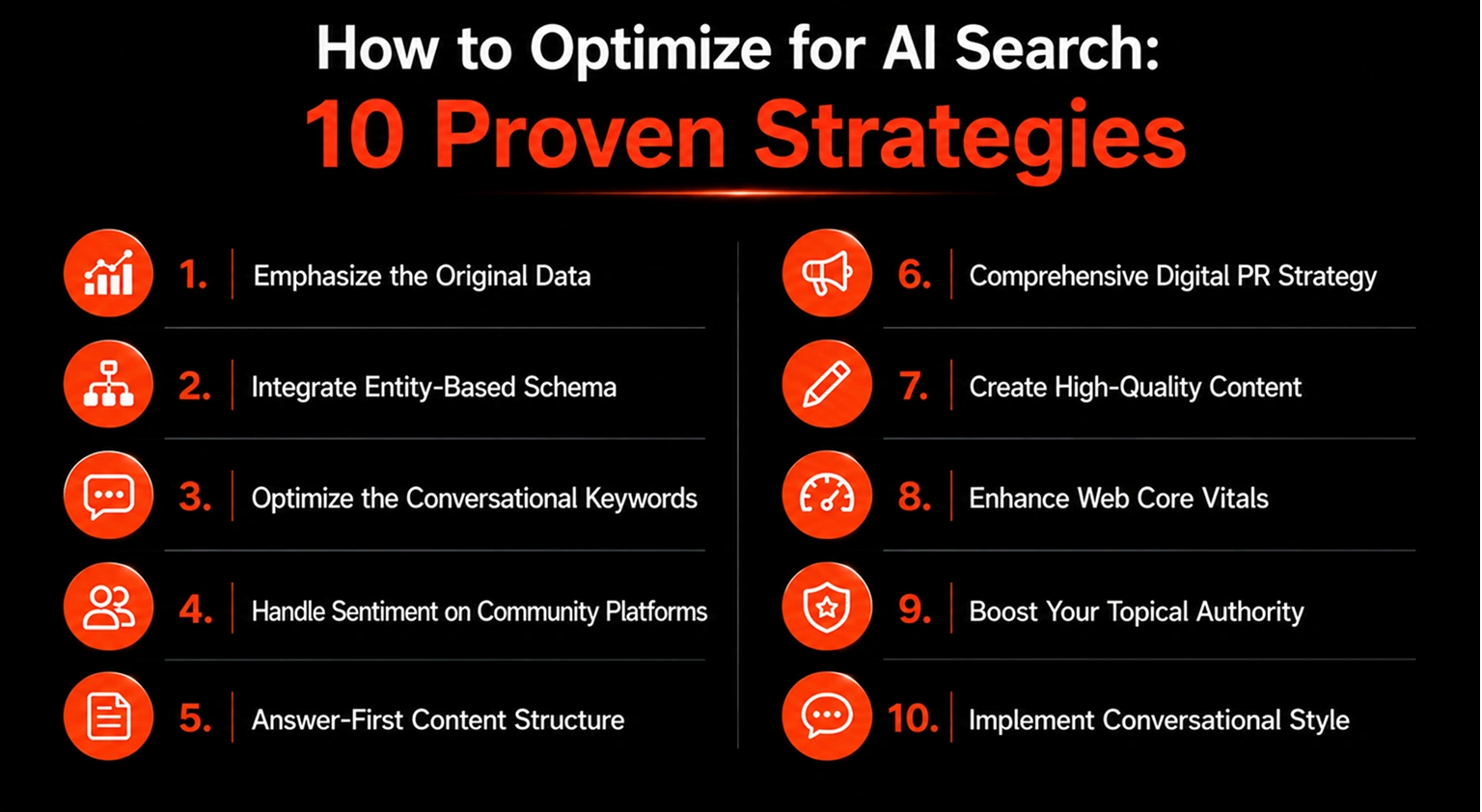
Emphasize the Original Data
LLMs are always looking for new information. Mostly they have already memorized Wikipedia. If you would conduct an original survey of different content and publish it by a Branding Agency in Jaipur. Then the AI engine will cite you as the primary source of information because it indicates the high-authority signal of your results in AI search.
Integrate Entity-Based Schema
Meta descriptions are not so important anymore. The AI bots now search for JSON-LD. Make use of “SameAs” attributes to connect your website to your Wikipedia page and your social media accounts. This way you have your identity built into your website. There will be no confusion about Infinix being one entity.
Optimize the Conversational Keywords
The user talks to the AI, not enters any keyword searches. The user asks if the phone can play certain games at a certain number of frames per second. To properly optimize for an AI search, you have to mimic what the user actually says.
Handle Sentiment on Community Platforms
AI models will crawl on Reddit, Quora, and Discord. The main thing is the community will solve problems in a positive manner for your software updates. The AI also interprets this as high brand trust. You need to also engage with the community, not just for PR but also for technical LLM visibility in AI search.
Answer-First Content Structure
The AI algorithms always give precedence to what is easily extractable from the content. The trick here is to lead your content with a clear-cut summary of 50 words that answers the main question. If your introductory text can be copied and pasted by the algorithm in its response, it will be.
Comprehensive Digital PR Strategy
LLM regards sites such as GSMArena and TechRadar as the epitome of truth. One appearance on either of the two sites is better than thousands of other regular backlinks. Such are high-authority nodes in the worldwide knowledge graph, and when they authenticate your hardware claims, the AI takes note of that fact.
Create High-Quality Content
Content is the main base of a reliable SEO strategy. The AI search engines will examine that content, which should be different than traditional search algorithms. AI algorithms give priority to material that actually answers users’ concerns and offers significant value, rather than rewarding pages with the highest keyword density.
Enhance Web Core Vitals
If your website is slow, then the best content will also not help you to get the best results. Page experience is an important factor that represents the website content in searches. The fast website will provide better user experience for visitors and AI crawlers. The website speed mainly depends on 3 elements: LCP (Largest Contentful Paint), INP (Interaction to Next Paint), and CLS (Cumulative Layout Shift)
Boost Your Topical Authority
Topical authority implies that one publishes quality content for all the aspects of a topic. Unlike traditional search engines, AI search engines judge not just individual webpages but the whole website with regard to its expertise in a particular topic.
Implement Conversational Style
AI-based search engines are intended to comprehend natural language, and so natural language content is more relevant now than before. Unlike conventional SEO techniques, which involved repetition of certain keywords, AI-based search engines give preference to content that is natural and answers user queries.
Future Trends in Answer Engine Optimization
As AI-powered search keeps evolving, answer engine optimization is going to slide past the usual SEO stuff. Companies really need to get ready for new tech, shifts in how people search, and AI-driven checks that decide whether content is worthy, just so they can keep showing up in those future answer engines.
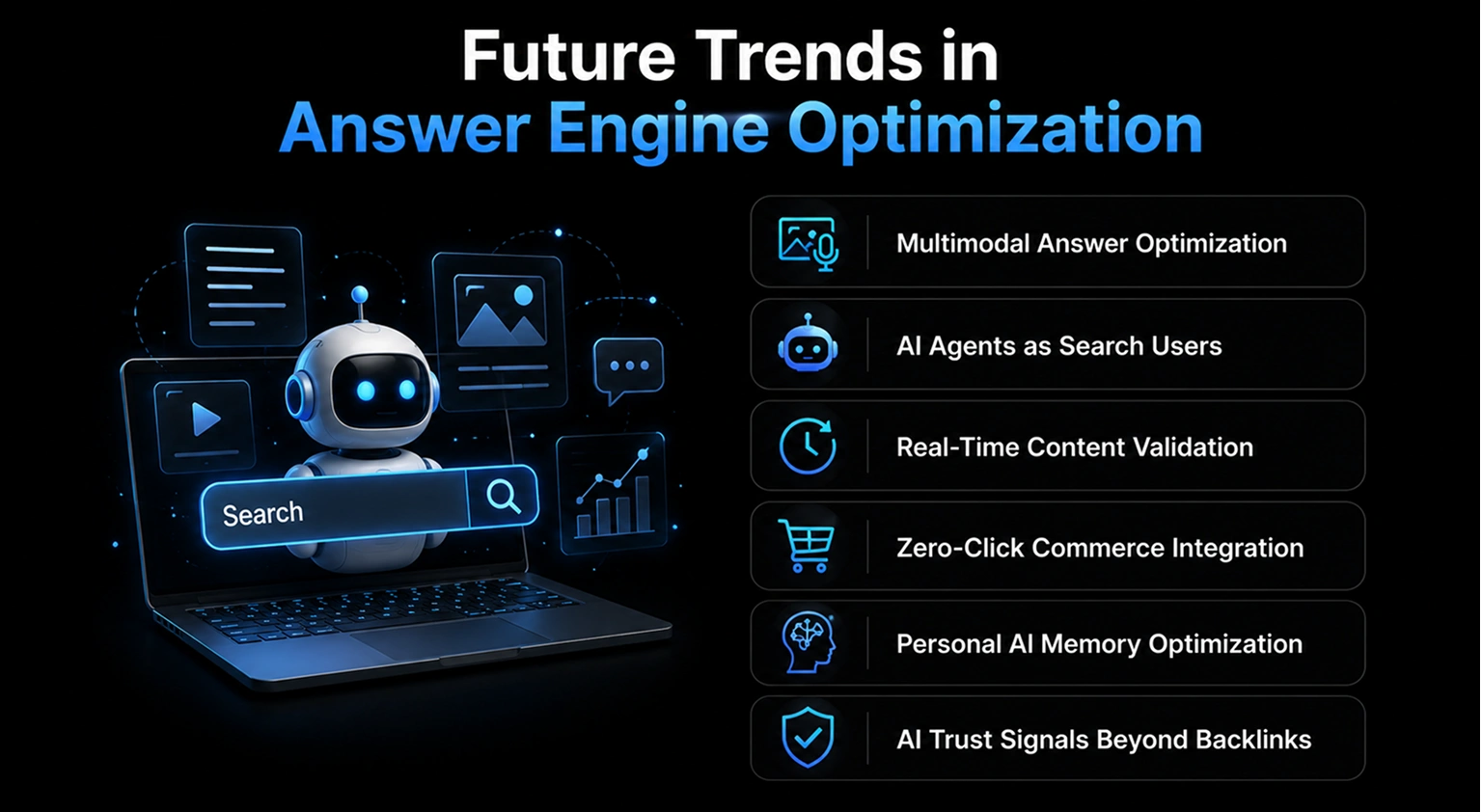
Multimodal Answer Optimization
In the near future, answer engines will handle words plus images, videos, PDFs, and audio all together. So brands will have to optimize different content types, not just pages, to help AI “get it” about being included in answers.
AI Agents as Search Users
Autonomous AI agents will act like researchers; they’ll scan, compare, and suggest products for the user in SEO Services in Jaipur. That means content needs to be machine-readable, dependable, and shaped in a way that’s easy for AI to use when making decisions, not just nice for humans.
Real-Time Content Validation
Answer engines are likely to prefer information that stays fresh and is continuously updated rather than static pages that sit there unchanged. Businesses will need a more lively approach so their accuracy doesn’t drift out of date.
Zero-Click Commerce Integration
AI assistants will allow users to finish purchases, book services, or start subscriptions right inside the conversation. Less website hopping means transactional content becomes even more important, and it has to be optimized for action, not merely attention.
Personal AI Memory Optimization
Some future AI tools may build answers around a specific person’s preferences and earlier interactions from a reliable SEO Company in Jaipur. So businesses will want to craft highly personalized, context-aware content experiences, because generic messaging might get skipped.
AI Trust Signals Beyond Backlinks
Future ranking systems may lean more on factual correctness, source credibility, expert review, citations, and consistency of the content, rather than traditional backlink-based authority. In other words, digital credibility gets redefined, and “link juice” alone won’t carry the weight the same way.
Final Thoughts
AI search does this by prioritizing being the most relevant and trustworthy answer to a user’s query over having the top page rank in search engines. As search engines have become more sophisticated and have started to better understand intent and meaning, the SEO war has moved from page rank to relevance.
The future of digital marketing is therefore how clearly you communicate and structure your content, for both users and machines, and how much trust you build: It’s all about the user experience from a comprehensive Full-Funnel Digital Marketing in Jaipur. The AI visibility pyramid, content optimization, and all the things we’ve talked about have one goal: to be recognized as an authority, not just to be found.
Key takeaways
- AEO optimizes for being extracted and cited by AI answer engines — not for a blue-link ranking.
- SEO wins clicks; AEO wins citations in zero-click answers on ChatGPT, AI Overviews and Perplexity.
- AI engines split a question into sub-searches and assemble one answer from several sources.
- Highest-leverage moves: original data, entity-based schema, answer-first structure and digital PR.
- Next wave: multimodal answers, AI agents as users, real-time validation and trust signals beyond backlinks.
Frequently asked questions
AEO is an optimization of content on a website so that AI-powered search engines and assistants will give an accurate answer. It makes the content visible through different AI-powered searches.
Optimize a website by creating quality, structured content, using schema markup, giving clear answers to user queries, improving page experience, and maintaining topical authority for AI-powered search engines.
AI overview optimization includes publishing authoritative content, showcasing expertise, answering the queries of the users directly, using structured data, gaining quality backlinks, and updating content periodically.
AI search optimization involves publishing high-quality and well-structured content, optimizing according to the user intent, implementing schema markup, maintaining technical SEO, and building topical authority to be used as a reference.
Publish quality and factual content, answer questions in a concise manner, use structured data, strengthen EEAT signals, optimize technical SEO, and publish related content to get AI Overview eligibility.
Keep your existing SEO foundation — quality content, technical optimization, backlinks — and layer AEO on top by structuring content with clear answers upfront, adding schema markup, and targeting conversational, intent-based queries.
Lead with clear, extractable answers, use schema markup, publish original data, and keep content updated so AI engines see you as an accurate, trustworthy source.
Still deciding?
Tell us your goal — we’ll point you the right way
No pitch, no pressure. Share where you’re stuck and we’ll reply with a clear next step.
- A reply within 24 hours, from a real strategist.
- A clear next step tailored to your goal — not a sales pitch.
- Your details stay private. No spam, ever.