Why Ads Alone Don’t Work: Funnel-Based Performance Marketing Explained
Running ads without a funnel is just burning budget. Here's why funnel-based performance marketing outperforms standalone ads — plus a step-by-step guide to building a TOFU-MOFU-BOFU system that actually converts.

TL;DR: You’re not wasting money because your ads are bad. You’re wasting money because you’re showing the right ad to the wrong person at the wrong time. A funnel fixes that — and that’s exactly what this article breaks down.
The Real Reason Your Ads Are Not Converting
You set the budget, designed the creative, and finally hit “Go” on your Meta or Google campaign. Then you wait. And the leads either never show up — or the ones that do never buy.

Sound familiar?
Here’s the uncomfortable truth most agencies won’t tell you: the problem is rarely the ad itself. The problem is that you’re asking a stranger to marry you on the first date.
In 2026, the average buyer interacts with a brand 7 to 13 times before making a purchase decision. A single ad is just one of those interactions. Without a system to capture that person, warm them up, and convert them across the rest of those touchpoints, you’re essentially setting fire to your ad spend.
That system is called a marketing funnel. And performance marketing without one is like running a tap with no bucket underneath — everything you pour in just drains away.
- 7–13x — touchpoints before a purchase decision
- 17% — of the buying journey spent talking to a seller (Gartner)
- 40% — better lead quality with a full-funnel approach
- 30% — lower customer acquisition cost with a funnel vs. standalone ads
What Is Funnel-Based Performance Marketing?
Funnel-based performance marketing is a strategy where every ad, every piece of content, and every campaign is built for a specific stage of the buyer’s journey — not just the final sale.
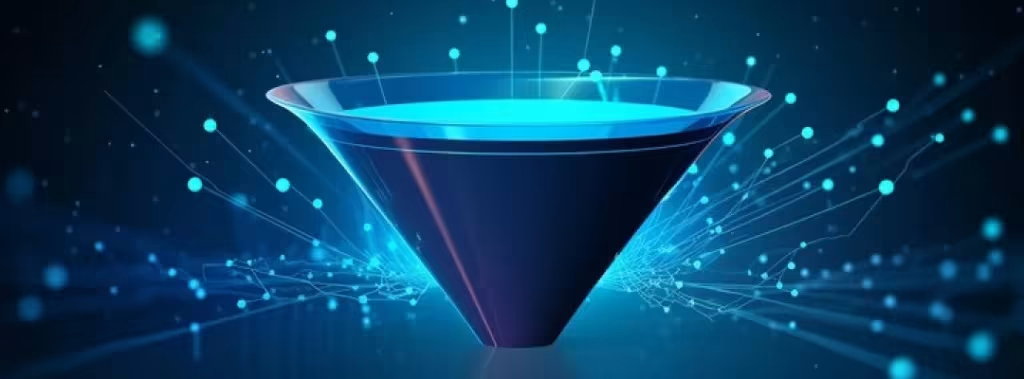
Instead of blasting one generic “Book Now” or “Buy Today” ad at everyone, you build a layered system:
| Funnel Stage | Audience Mindset | Goal | Ad / Content Type |
|---|---|---|---|
| TOFU — Top of Funnel | “I have a problem but I don’t know the solution yet.” | Awareness & reach | Educational reels, blog posts, brand videos, awareness ads |
| MOFU — Middle of Funnel | “I know solutions exist. Who should I trust?” | Consideration & trust | Case studies, testimonials, retargeting ads, comparison content |
| BOFU — Bottom of Funnel | “I’m ready to buy. Just convince me you’re the right choice.” | Conversion | Offer ads, lead forms, demo CTAs, limited-time promotions |
| Post-Funnel | “I bought. Did I make the right choice?” | Retention & referral | Onboarding emails, upsell campaigns, review requests |
Key insight: Most businesses only run BOFU ads — and then wonder why costs are high and conversions are low. Cold traffic doesn’t respond to “Buy Now.” You have to earn the bottom of the funnel by investing in the top.
The 5 Most Common Reasons Ads Fail (And How a Funnel Fixes Each)
1. You’re Targeting Cold Audiences With Conversion-Stage Messaging
Showing a “Get a Free Quote” ad to someone who has never heard of you is one of the biggest budget killers in performance marketing. That person doesn’t trust you yet — so why would they hand over their details?
Funnel fix: Use TOFU content (educational videos, awareness campaigns) to introduce your brand first. Then retarget the people who engaged with your BOFU offer.
2. Your Landing Page Does Not Match the Ad
Even a perfect ad fails if the landing page doesn’t continue the conversation. If your ad promises a “free consultation” but the page sells a package, the visitor bounces — and you paid for that click.
Funnel fix: Give each stage of the funnel a dedicated landing page with messaging aligned to exactly where that visitor is in their journey.
3. You’re Running Ads Without Any Retargeting
Only 2–3% of website visitors convert on the first visit. Without retargeting, you’re quietly writing off 97% of the traffic you already paid for.
Funnel fix: Build retargeting audiences from people who visited your site, watched 50%+ of your video, or clicked but didn’t convert. These are your warmest, cheapest-to-close leads.
4. No Nurturing System After the Lead Is Captured
Getting a lead is just the beginning. If your only follow-up is a single call or a lone WhatsApp message, most leads will go cold before your sales team even reaches them.
Funnel fix: Set up an automated nurturing sequence — a mix of emails, WhatsApp follow-ups, and retargeting ads — that keeps your brand top-of-mind until the prospect is ready to convert.
5. Measuring Only ROAS Instead of Full-Funnel Metrics
Return on Ad Spend (ROAS) is a useful number, but it only tells you what happened at the bottom. It hides the questions that actually matter: where are people dropping off, and which stage needs work?
Funnel fix: Track metrics at every stage — reach and CPM at TOFU, CTR and engagement at MOFU, CPL and conversion rate at BOFU.
A Real-World Example: Real Estate Lead Generation With a Funnel
Say you’re a real estate developer in Jaipur. You run Meta ads that ask people, cold, to “Book a Site Visit.” The result? High CPL, low show-up rate, and a frustrated sales team chasing tyre-kickers.
Here’s how a funnel-based approach transforms that same spend:
- TOFU (Awareness): Run a 30-second Instagram reel showing a virtual walkthrough of the property. No hard sell — just beautiful visuals and an emotional hook. Goal: reach and video views.
- MOFU (Consideration): Retarget people who watched 50% of the video with a carousel ad — testimonials from happy homeowners, project highlights, transparent price ranges. Goal: website clicks and lead-form opens. This is where brand image does the heavy lifting: what customers perceive matters more than what you intend.
- BOFU (Conversion): Retarget website visitors with a limited offer — “Book a Site Visit This Weekend, Get Priority Allotment.” Goal: lead-form submissions.
- Post-Funnel (Nurture): Every lead gets a WhatsApp message within 5 minutes plus a 3-email sequence over 7 days with EMI calculators, neighbourhood guides, and FAQ answers. Goal: show-up rate and bookings.
What changes? CPL drops because you only run conversion ads to warm, pre-qualified audiences. Show-up rates improve because leads are nurtured before they arrive. And your sales team closes faster because leads already trust the brand.
Funnel-Based Marketing for D2C and E-Commerce Brands
For D2C brands, the funnel looks a little different, but the principle is identical. Here’s a framework built for product-based businesses:
- TOFU: UGC-style reels and problem-aware content that shows why the product category matters. Run to lookalike audiences.
- MOFU: Comparison content, “how it works” explainers, and a customer-reviews carousel. Run to engaged video watchers and website visitors.
- BOFU: Direct product ads with an offer — free shipping, a first-order discount, or limited-stock urgency. Run to add-to-cart abandoners and high-intent visitors.
- Post-Purchase: An email and WhatsApp sequence for reviews, upsells of complementary products, and referral-program activation.
Brands that implement this structure typically see a 30–40% reduction in Customer Acquisition Cost (CAC) compared to running isolated “Shop Now” ads.
How to Build Your Performance Marketing Funnel: A Step-by-Step Guide
Step 1: Define Your Audience at Each Stage
Before you spend a single rupee on ads, map out who your TOFU, MOFU, and BOFU audiences actually are. Use Meta’s Audience Insights and Google Analytics to understand the demographics, interests, and behaviour of people at each stage.
Step 2: Create Stage-Specific Content and Ad Creatives
TOFU content should educate and entertain, not sell. MOFU content should build trust and differentiate. BOFU content should remove objections and create urgency. A single “buy now” creative can’t do all three jobs at once — stop asking it to.
Step 3: Set Up Your Retargeting Audiences
In Meta Ads Manager and Google Ads, create custom audiences for: video viewers (25%, 50%, 75%), website visitors by page, lead-form openers who didn’t submit, and past customers (for upsell and referral campaigns).
Step 4: Build Your Landing Pages for Each Stage
TOFU traffic goes to a blog or brand-video page. MOFU traffic goes to a case study or services page. BOFU traffic goes to a dedicated conversion landing page with a single, clear CTA and zero distractions.
Step 5: Install Proper Tracking and Pixels
You can’t optimise what you can’t measure. Install the Meta Pixel, Google Tag Manager, and conversion events for every action that matters — page view, button click, form submit, purchase. That data feeds back into your ad algorithms and sharpens your targeting over time.
Step 6: Set Up a Lead-Nurturing Sequence
Every lead that enters your funnel should get immediate follow-up (within 5 minutes), a multi-touch nurturing sequence over 7–14 days, and a re-engagement campaign for leads that go cold after 30 days.
Step 7: Test, Measure, and Optimise Weekly
Run A/B tests on your creatives, headlines, and CTAs at each funnel stage. Review your funnel metrics weekly — not just ROAS — and find the stage with the highest drop-off. That’s where your next optimisation effort goes.
Key Metrics to Track at Every Funnel Stage
| Funnel Stage | Metric to Track | 2026 Benchmark (Top Performers) |
|---|---|---|
| TOFU | Reach, CPM, video view rate | Video view rate > 30% = strong creative |
| MOFU | CTR, engagement rate, time on page | CTR > 2% on retargeting ads |
| BOFU | CPL, conversion rate, lead-to-sale rate | Visitor-to-lead: 8–15% for top performers |
| Post-Funnel | Repeat purchase rate, NPS, referral rate | Lead-to-SQL: 35%+ for high-quality funnels |
Why Most Agencies Don’t Build Funnels (And Why That Hurts You)
Most performance marketing agencies focus on media buying — chasing the cheapest clicks and the highest ROAS on paper. But they rarely own the full customer journey. They don’t build your landing pages. They don’t set up your nurturing sequences. They don’t track what happens after the lead is generated.
The result? Metrics that look great on a dashboard but never translate into actual revenue for your business.
What Happens When Agencies Skip the Funnel
At BoostronixX, we believe performance marketing only performs when it’s connected to a strategy. That means brand positioning, creative development, funnel architecture, landing-page design, and data-driven optimisation — all working together as one growth system. Understanding the difference between brand strategy and marketing is what separates brands that scale from brands that stall.
Key takeaways
- The average 2026 buyer needs 7–13 touchpoints before purchasing — a single ad is just one, so standalone ads leave money on the table.
- Most brands fail by running only BOFU 'Buy Now' ads to cold audiences; you have to earn the bottom of the funnel by investing in the top.
- A full TOFU-MOFU-BOFU-plus-nurture funnel typically cuts Customer Acquisition Cost by 30–40% versus isolated ad campaigns.
- Retargeting is non-negotiable: only 2–3% of visitors convert on the first visit, so without it you're writing off 97% of paid traffic.
- Stop judging campaigns on ROAS alone — track reach and CPM at TOFU, CTR at MOFU, and CPL at BOFU to see where leads actually drop off.
Frequently asked questions
Budget is rarely the real problem. Most ads fail because they show conversion-stage messaging to audiences who aren’t ready to buy yet. Building a proper TOFU-MOFU-BOFU funnel fixes this by warming up audiences before you ever ask for the conversion.
It’s a performance marketing strategy that assigns specific ad types, content formats, and messaging to each stage of the buyer journey — Awareness, Consideration, and Conversion — so every campaign works together to move prospects toward a purchase, instead of blasting one generic sales ad at everyone.
Improve the middle of your funnel. Warm audiences convert at a lower cost and higher quality than cold traffic. Retargeting engaged users, lifting landing-page conversion rates, and tightening audience targeting all drive CPL down without sacrificing lead quality.
Digital marketing is a broad umbrella covering SEO, content, social media, and paid advertising. Performance marketing specifically means paid campaigns where you track and optimise for measurable outcomes like leads, sales, or app installs — you pay for results, not just visibility.
Most businesses see meaningful gains in lead quality and conversion rates within the first 4–6 weeks of running a proper funnel. Full optimisation, where every stage is performing at its peak, typically takes 2–3 months of continuous testing and iteration.
No. A well-structured funnel is often more cost-efficient than a large budget spent on unfocused ads. Starting with a modest TOFU awareness budget (even ₹5,000–₹10,000/month) to build retargeting audiences, then concentrating conversion spend on warm audiences, beats spending everything on BOFU ads to cold traffic.
Still deciding?
Tell us your goal — we’ll point you the right way
No pitch, no pressure. Share where you’re stuck and we’ll reply with a clear next step.
- A reply within 24 hours, from a real strategist.
- A clear next step tailored to your goal — not a sales pitch.
- Your details stay private. No spam, ever.